PHILADELPHIA (April 2, 2026) — Philadelphia District Attorney Larry Krasner, DAO DATA Lab and justice partners collaboratively release a report on Philadelphia’s Accelerated Misdemeanor Program (AMP), which is a pre-trial diversion program for defendants charged with non-violent offenses and who have minimal criminal history. This program promotes accountability, public safety and support for victims of crime. It is offered at the discretion of the DAO’s Adult Diversion Unit, under the leadership of Supervising Assistant District Attorney Caleb Arnold.
As we enter into April, the Philadelphia District Attorney’s Office recognizes the season of renewal the month brings, signaling hope, opportunities and second chances. The DAO is releasing the Accelerated Misdemeanor Program (AMP) report to coincide with this season of renewal and the office’s mission to deliver individual, even-handed justice to those within Philadelphia’s criminal legal system, while providing support to victims and communities impacted by crime. The AMP report shows the impact of deploying a program that addresses those affected by quality-of-life related crimes.
AMP has been operating since 2010 and has undergone multiple implementation changes. The program briefly ceased operations during the COVID-19 pandemic, before restarting in August 2022. This report provides an overview of AMP data over the last 3 years from August 2022 to August 2025.
The report shows six key takeaways:
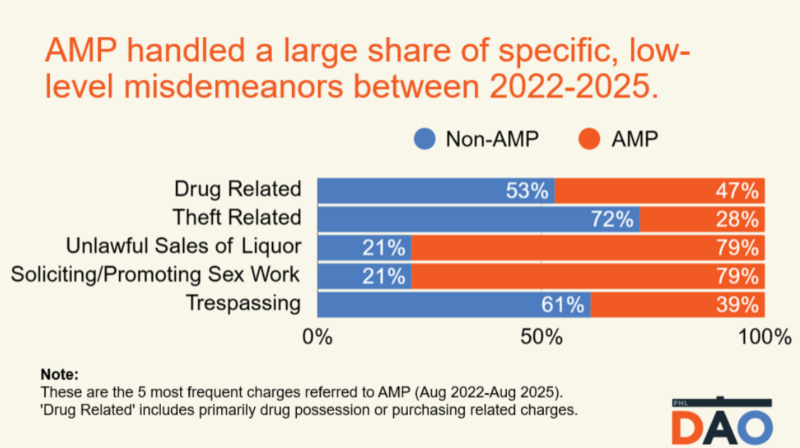
- AMP handles a large proportion of specific, low-level misdemeanors, including nearly 50% of all drug-related misdemeanors in Philadelphia’s Municipal Court since 2022.
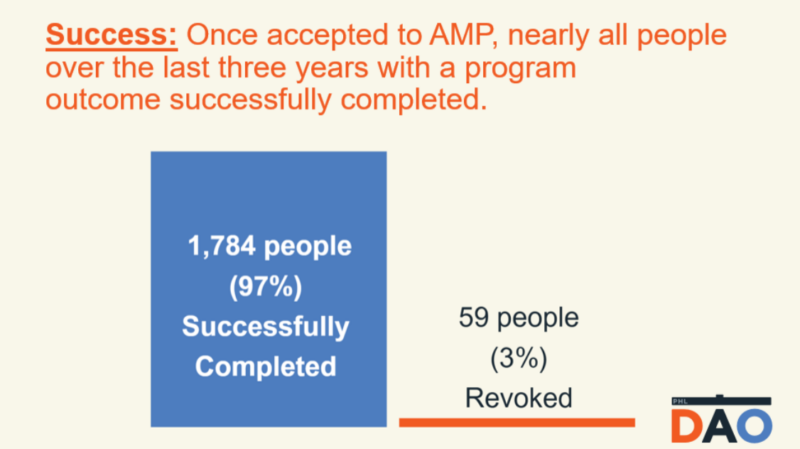
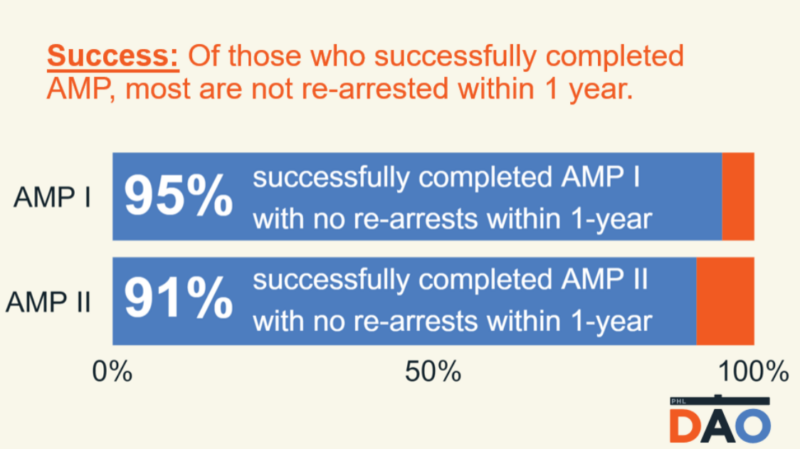
- Defendants who successfully completed AMP had a low 1-year re-arrest rate (roughly 5% in AMP I, and 9% in AMP II).
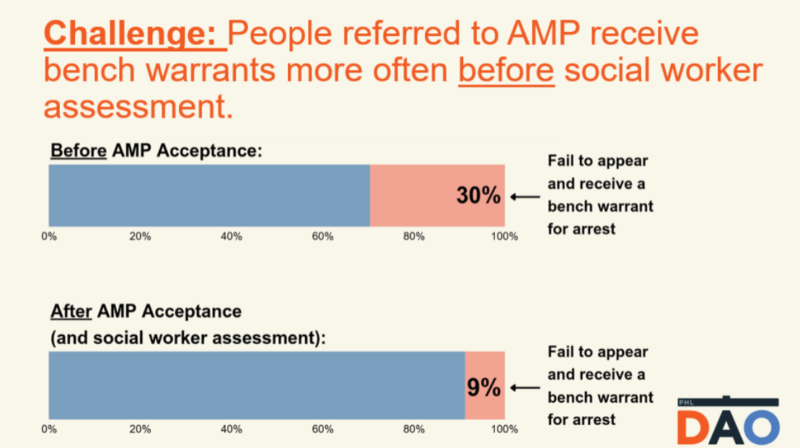
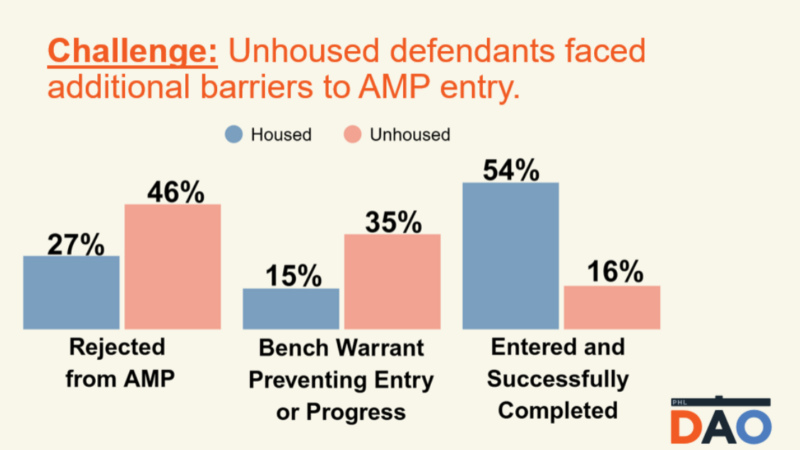
- Nearly 30% of defendants referred to AMP fail to appear in court before accepting services and are issued a bench warrant for arrest. However, of those who do attend their court date, are assessed, and accept AMP services, less than 10% later fail to appear end up being issued a bench warrant.
- Unhoused AMP defendants face additional barriers to entry resulting in higher rejection and bench-warrant rates, but have a near identical successful completion rate to housed defendants once accepted.
- Philadelphia can achieve historical reductions in violence and crime, while also achieving success in Diversion Programs, such as AMP.
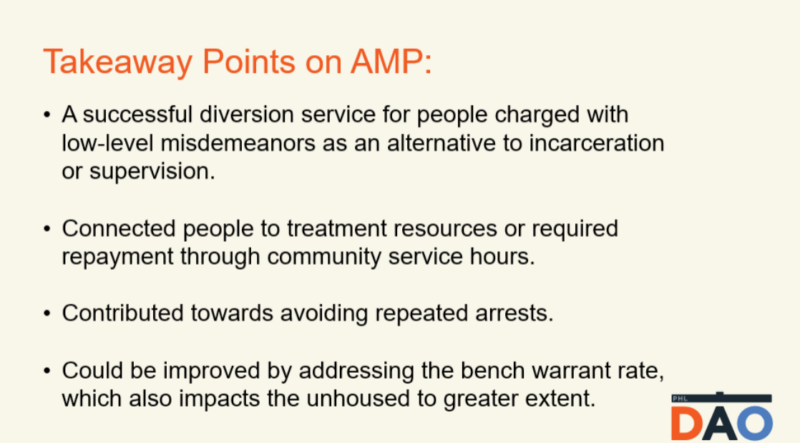
The Accelerated Misdemeanor Program (AMP) is one of Philadelphia’s largest diversion programs, which operates in partnership with the First Judicial District (FJD), the Defender Association of Philadelphia, and Public Health Management Corporation (PHMC). Defendants charged with primarily non-violent misdemeanor crimes are referred to AMP, and upon acceptance into the program, complete either community service or treatment plans to avoid convictions that damage their futures. The program represents a significant off-ramp, particularly for low-level drug-, theft- or some more specific charge categories. For example, the majority of cases charged with unlawful liquor sales or soliciting sex work are referred to AMP for resolution.
AMP offers two distinct tiers (AMP I & AMP II) and not all defendants are eligible for AMP. Defendants arrested and charged with low-level, misdemeanor crimes can be reviewed by the DAO Adult Diversion Unit for AMP eligibility. AMP I accepts people with no or minimal prior criminal history, while AMP II accepts people with past non-violent misdemeanor offenses. Cases may be disqualified from entering AMP I if defendants have prior arrests and convictions, or the current case involves higher level charges or victims with injury. Each case referral is individually reviewed by an Assistant District Attorney (ADA) to ensure eligibility and appropriateness for the program. Importantly, the DAO’s Adult Diversion Unit makes efforts to work with defendants with a wider range of charges when complainants want diversion (and as agreed upon between FJD and the Defender Association).
The DAO recognizes that an overreliance on incarceration in response to wrongdoing makes communities less safe and less prosperous. By not addressing underlying contributors to crime, such as poverty, mental illness, and substance use, we risk increasing recidivism rates, creating higher costs for city taxpayers, and perpetuating cycles of trauma for families and communities. To mitigate these harms, the DAO offers several diversion programs and connects defendants to services that address these underlying issues and divert individuals from prosecution and incarceration.
“The outcome of the DAO’s AMP Report shows the importance of diversion, especially for low level, non-violent misdemeanor crimes,” said District Attorney Larry Krasner. “Eligible individuals are able to come into the program, connect to social services or engage in community service, and participate in an outcome as an alternative to prosecution and incarceration. Using tools like AMP allows us to work within a criminal legal system that will give people an opportunity for a second chance at life, while also making sure victims and co-victims are supported and made to feel whole in the process.”
“This report shows that AMP is a program that works,” said ADA Caleb Arnold, Supervisor of the DAO’s Adult Diversion Unit. “The Accelerated Misdemeanor program supports the prevention of crime in the long term, while also helping Philly residents and victims impacted by crimes feel safe in their communities in real time.”
The Accelerated Misdemeanor Program report was authored by the D.A.T.A. Lab, with support from Adult Supervisor ADA Caleb Arnold, AMP Supervisor ADA Kathryn Price, and the AMP ADAs and paralegals who shared their invaluable insight and feedback.
The DAO would like to thank the judges and First Judicial District (FJD) staff, the Defender Association of Philadelphia, and Public Health Management Corporation (PHMC) for making this collaborative work possible.