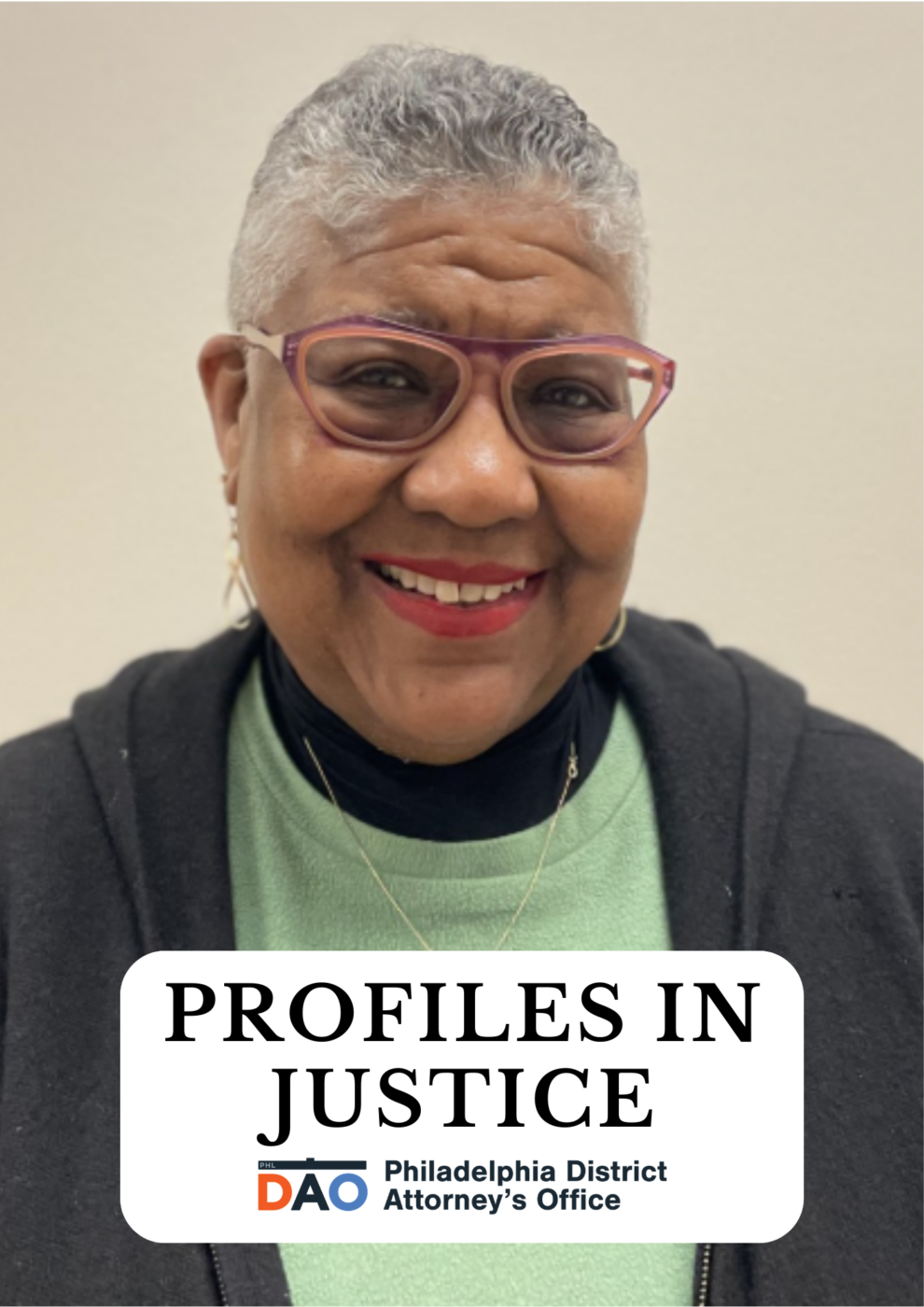
By Dustin Slaughter
Christina Bradley’s life and career reflect a steady commitment to justice, compassion, and service to vulnerable young people in Philadelphia. A graduate of Penn State (BS) and St. Joseph’s University (MS), Tina’s path to criminal justice began in a distinctly unusual manner. As a college student, she would sit in the dining hall listening to a classmate talk enthusiastically about becoming a private detective like the fictional character Honey West, who was featured in the titular television series that aired briefly in the mid-1960s. Intrigued, Bradley followed her friend into a newly established major within the College of Health and Human Development, which also included criminal justice education. She graduated in 1974, equipped with a degree and a sense that she wanted to make a change within Philadelphia’s criminal justice system.
While finishing college and in the year immediately following graduation, Tina worked the night shift at a photo processing plant. The long hours—sometimes ending at three or four in the morning—were demanding. In addition, she also accepted substitute teacher assignments in the School District of Philadelphia. During that period, she visited a friend whose brother happened to be the Supervisor of the record room at the Defender Association of Philadelphia.
“When he learned that I worked at night, he was like, No, I don’t believe in women working at night. I can get you a job. You come down to my office and I’ll get you an interview. And that’s how I started working at the public defender’s office.”
In 1975, she began a decades-long career at the Defender Association.
Tina began serving as an administrative aide and relief switchboard operator. Though grateful for the job, she hoped to transition into a role more aligned with her criminal justice degree. Because the Defender Association functions as a public defender law firm, her academic background proved relevant. In 1979, she was offered a position as a social worker in the Defender’s Child Advocacy Unit (CAU), working with children involved in the dependency court system and with DHS, an opportunity that felt like a natural fit, given her professional training, education, and life experience.
Having been raised in North Central Philadelphia, living through the riots of the 60’s and the deterioration that brought to her low-income community, Tina understood life’s hardships. Formative experiences, including her parents’ separation, resulted in her having to finance her own education at Penn State while her mother worked to care for her younger siblings. This adversity helped her empathize with clients facing similar challenges.
Tina was comfortable conducting home visits throughout the city in communities much like the one in which she was raised. She became a steady presence for children and families facing difficult challenges. Her dedication and hard work did not go unnoticed. After her first year in the CAU, when a vacancy opened in the Defender’s Juvenile Social Services Unit (JSS), the Director invited her back, this time as a social worker in the unit where she had once provided administrative support. Tina spent over a decade in the JSS, assisting attorneys representing arrested youth. During this time, she gained a reputation as a strong advocate for young clients. In addition to the responsibilities of visiting clients in detention and advocating in courtrooms, Tina traveled throughout the state and country visiting clients in residential facilities, helping to ensure their safety and reporting abuses.
The mid-1990s marked a pivotal shift in juvenile justice in Pennsylvania. In 1996, legislation permitted certain juveniles to be directly charged in adult court, a stark reversal of longstanding legal practice. As the Defender Association expanded its Juvenile Special Defense Unit to respond to this change, Tina applied for a position working with “direct file” juveniles. The role required her to visit correctional facilities located on State Road in Philadelphia and interview young people in custody. For two years, she navigated prisons and courtrooms, gathering pertinent mitigation to assist in advocating for youth whose futures were at risk of being permanently damaged by adult prosecution. Her leadership and expertise led to her promotion as Director of Juvenile Social Services (1999), where she oversaw efforts to support and defend young clients within a rapidly changing justice landscape.
In 2019, Tina was invited by DA Krasner to join the Philadelphia District Attorney’s Office.
“I’ve known Larry Krasner for many years. I knew his heart. And I felt that if he wanted me to come over here, that there had to be a good reason for it.”
She joined the office in part to help with juvenile diversion expansion initiatives and to share her decades of institutional knowledge and community relationships with a new generation of attorneys. The transition from defender to prosecutor’s office has not been as challenging as some might think because of the vision that Larry and now-retired DAO First Assistant, Robert Listenbee.
Since her arrival, Tina has contributed to the expansion efforts for Juvenile Diversion, connecting the unit with significant community-based programs and those in leadership positions at various agencies and programs with whom she has had long-standing relationships. She has assisted with the hiring and onboarding of diversion staff and continues to support with consultations to both staff and program partners. While assisting with a parent and youth focus group in 2024, Tina conceived the idea for an ongoing parent support group for the parents of youth who have completed their diversion contracts. That program, the Guardian Empowerment League (GEL), continues to grow and lend support to families after they have completed official “system involvement”.
In addition, Tina supports Project GO, the DAO truancy intervention and prevention program. The initiative partners exclusively with over 70 charter and cyber schools that do not have access to the type of supportive services provided by the Department of Human Services (DHS) to traditional public-school students before Family Court involvement. Project GO supports school staff in their efforts to address issues that result in chronic absenteeism. Tina views the work as critically important to preventing deeper system involvement for students served by those alternative educational settings. Her favorite part of the work is when she can provide support and address barriers that impact students’ regular attendance.
Outside of the office, Tina finds joy in creativity and serving those less fortunate than herself. Skilled in crocheting, she gifts baby blankets and clothing to new mothers and contributes her craft to charitable causes.
She also founded a similar initiative with her sorority.
“As a cancer survivor, Project Chemo Crochet is important to me, and it involves crocheting squares and then mailing them to the organization. So I helped get that started in my sorority chapter, which then they expanded it into crocheting full Afghans and blankets, which they are now delivering to folks in nursing homes.”