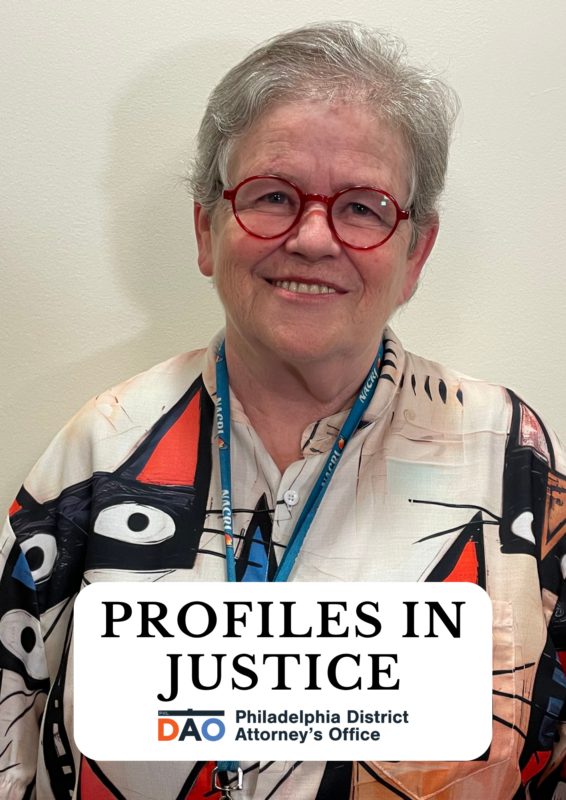
By Dustin Slaughter
Jody Dodd brings decades of experience in peacebuilding, social justice, and restorative practices to her work at the Philadelphia District Attorney’s Office. Trained in restorative practices by Quakers in the early 1980s, Dodd describes her professional path as “an interwoven thing of nonviolence and peace as the values of restorative justice.” Her background includes work as a nonviolence trainer, political activist, and human rights advocate, including service with the Women’s International League for Peace and Freedom, where she participated in Women, Peace, and Security delegations at the United Nations and met with women using restorative practices in post-conflict regions such as Rwanda and Congo.
When Philadelphia District Attorney Larry Krasner invited her to join the DA’s Office, Dodd initially resisted. “The DA’s office puts people in jail. Why would I want to do that?” she recalled thinking, given her years working alongside criminal defense and social justice advocates. But she described an “epiphany moment” in realizing that prosecutors could “make different decisions, make better decisions,” and when Krasner told her she could build restorative justice programming inside the office, she was immediately committed to the job.
Since arriving at the DAO in 2018, Dodd has worked to create an office culture that is receptive to the power and promise of restorative justice, which is generally understood as repairing harm done to people as a form of accountability for the offender, not merely punishing them. While other prosecutors’ offices across the country have implemented restorative programming to varying degrees, the DAO had no such thing prior to 2018. She helped design and launch the office’s Youth Justice restorative program in partnership with community organizations including Healing Futures and Collective Climb, while also expanding restorative justice opportunities for adults through collaborations with community practitioners across Philadelphia.
Her day-to-day work includes reviewing referrals from assistant district attorneys, defense attorneys, and victims themselves, explaining the voluntary nature of restorative justice to participants, coordinating with attorneys and practitioners, and appearing in court when potential restorative cases are brought before a judge for consideration. “The very first thing I say to victims is [restorative justice] is absolutely voluntary,” Dodd explained. “If you don’t want to do it, it’s fine.”
She also serves as a consultant to the Community College of Philadelphia’s Restorative Justice Certification Program, and participates in a national network of restorative justice practitioners working within prosecutors’ offices.
Dodd points to both measurable outcomes and personal fulfillment as evidence of the work’s impact. Following the mass arrests during the 2020 protests after the murder of George Floyd, Dodd and community partners helped divert 235 protest-related cases into restorative justice processes. She describes Philadelphia’s restorative justice landscape as “a very collaborative community,” noting the rapid growth of trained practitioners and community-based hubs across the city.
Outside the office, Dodd finds joy in gardening, reading with a cup of tea on winter nights, spending time with friends, cheering for the Philadelphia Phillies, and being “Nana” to her grandchildren. But she says some of her deepest satisfaction still comes from the outcomes she witnesses through restorative justice itself. In a recent report by Healing Futures, findings show a 100 percent satisfaction rate among participants in the Healing Futures program. Dodd calls the result “amazing,” given that participants entered the process through deeply traumatic circumstances. “People talk about secondary trauma,” Dodd reflected. “I get secondary joy because I get to be with people who had a good outcome.”