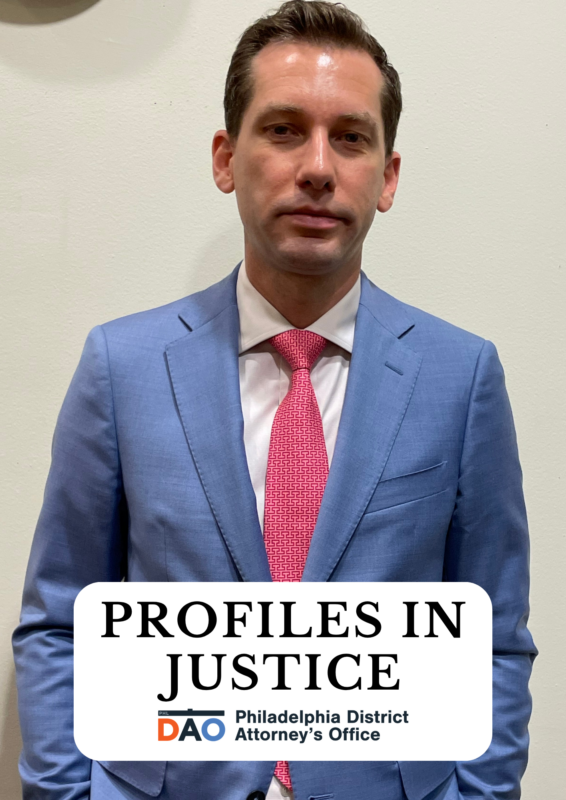
By Dustin Slaughter
Assistant District Attorney William Fritze has built an unusual career path within the Philadelphia District Attorney’s Office, rising from a victim advocate role to Chief of the Gun Violence Task Force through nearly two decades of service.
Fritze was raised in a small farming community in southern Michigan. After earning undergraduate degrees in criminal justice and political science from Michigan State University in 2003, he moved to Philadelphia where he spent two years with AmeriCorps VISTA helping establish school-based mentoring programs through Big Brothers Big Sisters of America. He joined the District Attorney’s Office in December 2006 as a victim advocate, later attending Widener University Delaware Law School. After graduating in 2012 and passing the bar exam, he became an assistant district attorney.
Fritze credits his years in victim services with shaping both his understanding of Philadelphia communities and his desire to become a prosecutor. “Victim services is really where I got the bug to be a prosecutor,” he recalled. Working closely with crime victims and observing courtroom proceedings gave Fritze a front-row seat to the justice system and convinced him that trial work was his calling. He says those experiences helped bridge the cultural gap between his rural Michigan upbringing and the realities of urban Philadelphia. “As a kid from Southern Michigan, I definitely was not going to be able to connect to people in Philadelphia until I had that kind of background,” he said. His progression at the DAO through Municipal Court, Juvenile Court, waiver court, and Major Trials provided him with broad experience before he transferred to the Gun Violence Task Force in 2018. During the COVID-19 pandemic, he became assistant supervisor of the unit and was later promoted to chief in November 2020.
As Chief of the Gun Violence Task Force, Fritze oversees a team whose mission extends beyond traditional prosecution. He describes the unit as an investigative operation focused on identifying and disrupting the individuals driving violent crime in Philadelphia. “Our time and our work is really focused more on lowering the crime rate, lowering the gun violence rate,” he explained. The task force combines prosecutors, criminal investigative analysts, and federal, state, and local law enforcement partners to build long-term investigations targeting repeat shooters and violent offenders. Fritze often refers to his prosecutors as “investigative district attorneys” because of the detailed work they perform, from drafting search warrants to analyzing cell phone extractions and social media evidence. “We are very tech heavy and technologically aware,” he said, noting that his attorneys have developed sophisticated digital forensics skills that help them build complex cases and support lengthy, evidence-driven trials.
Outside the courtroom, Fritze describes himself as a devoted family man whose greatest satisfaction comes from time spent with his wife and children. Family vacations, college sports, gardening, and home improvement projects occupy much of his free time. Reflecting on his profession, he remains deeply committed to public service. He frequently encourages law students to consider careers in prosecution. “It is, without exception, the best job that I’ve ever had in my life,” he said. While acknowledging the challenges and sacrifices involved, Fritze believes the opportunity to make a meaningful difference in people’s lives outweighs the financial rewards available elsewhere. “All it takes is one survivor saying thank you, and that’ll power you through another year.”