By Dustin Slaughter
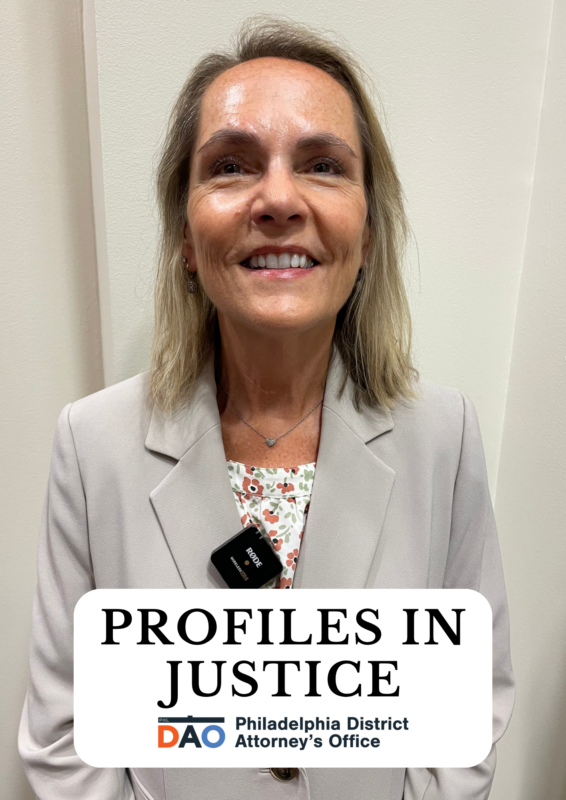
Assistant District Attorney Anne Marie Ambrose brings nearly four decades of experience in juvenile justice to her role as Special Advisor in the Philadelphia District Attorney’s Office Youth Justice Division. She brings the perspective of a former public defender, government administrator, and child welfare leader with a philosophy centered on accountability, diversion, and long-term public safety to her role. A Michigan native, Ambrose attended Michigan State University before earning her law degree from Emory University. Although she initially considered joining the Peace Corps, she credits clinical work in law school with steering her toward criminal justice. “It was the clinical work in law school that really got me hooked on criminal justice,” she said, recalling how work with prisoners’ rights organizations ultimately shaped her career.
Ambrose spent 13 years with the Defender Association of Philadelphia before leading juvenile justice under the Street administration, overseeing Pennsylvania’s secure juvenile facilities, serving as Commissioner of the Philadelphia Department of Human Services during the Nutter administration, and later directing work for a private child welfare foundation. She returned to public service when she joined the Philadelphia District Attorney’s Office in November 2025. “I never thought I would be a district attorney,” she acknowledged, explaining that she initially questioned whether prosecutorial work aligned with her longstanding belief that children should not be incarcerated unnecessarily. Ultimately, she was persuaded by what she viewed as the office’s commitment to diversion and measured use of prosecutorial discretion. “The power of prosecutorial discretion is truly awesome,” she said. “If you use it wisely, you can accomplish all the things that we want to accomplish.”
Today, Ambrose oversees a division that balances prosecutions involving serious crimes committed by juveniles with diversion initiatives designed to keep young people out of the justice system whenever appropriate. She emphasizes that many young defendants arrive in court after being failed by other institutions, including schools, child welfare agencies, and behavioral health systems.
“When we can get the other system partners to provide the services that young people and their families need, and divert a case, that is a success,” she said, describing diversion as the aspect of her work she finds most rewarding.
At the same time, she stresses that accountability and justice for victims remain essential in the most serious cases, particularly youth homicides, where prosecutors strive to achieve outcomes that both recognize victims’ losses and preserve the possibility of rehabilitation for youth who commit crimes.
As a leader, Ambrose describes herself as a hands-on mentor who begins each day reviewing cases, advising Assistant District Attorneys before court, observing proceedings, and providing detailed feedback afterward. She has made training and professional development a priority, believing young prosecutors should learn to pursue justice rather than simply convictions.
“Our job with juveniles is to have them take the right path,” she said. “They can make mistakes, but if we can get them on the right path, they’re better off. The community is better off, and it’s a win-win for everybody.”
Whether customizing assignments for new prosecutors or expanding diversion opportunities, Ambrose says her goal is to develop attorneys who understand that individual justice, community safety, and opportunities for young people can all coexist.
When not pioneering juvenile justice reform at the DAO, she enjoys spending time with her children, who are adults themselves, as well as spending time with her extended family at a house on the shores of Lake Huron.