By Christopher Oluwole, Ciara Sheerin, & Betsey Carroll
Philly Truce was founded in 2020 by childhood friends and schoolmates, Mazzie Casher and Steven Pickens. Mazzie and Steven were discouraged and highly concerned about the state of Black and brown communities in Philadelphia, particularly the financial, educational, and social barriers that long existed for these communities across the country. Their concerns were heightened by the consistent and upward trend of gun violence in Philadelphia. By the end of 2020, Philadelphia accumulated 499 homicides, the vast majority being shooting incidents perpetrated by men, with a growing number perpetrated by boys. For Casher and Pickens, this unfortunately mirrored their high school years, particularly 1990, when homicides hit at 500. The homicides once again grew in 2021 when the city experienced 562 homicides. Considering the advances and developments in technology, medicine, education, finance, social and moral movements, both men were dejected at the reality that Philadelphia’s safety was worsening. Casher and Pickens recognized a need for change. United in their belief that the advancement of physical, mental and socioeconomic conditions for Black Americans require an intentional shift in priorities, they founded Philly Truce with a goal of fostering sustainable Black manhood.

Image description: Philly Truce logo, blue text stating “Philly Truce” above hands shaking.
PHILLY TRUCE Mission and the Vision of Sustainable Black Manhood
Philly Truce’s mission is to drive the impact of Sustainable Black Manhood. The essence of Sustainable Black Manhood is crystallized in a vision that transcends conventional expectations, aiming for transformative change on multiple fronts.
TERMS OF SUSTAINABLE BLACK MANHOOD
- Zero involvement with the criminal justice system: Engage in no criminal activity.
- Zero involvement with the family court system: Engage in no unplanned paternity.
- Zero involvement with the state welfare system: Engage in no economically imbalanced lifestyle
- Infinite pursuit of self-knowledge: Seek cultural, familial, and personal self-knowledge.
- Infinite pursuit of useful education: Seek information that contributes to the synthesis of personal self-knowledge into a personal mission.
Community Violence Intervention & Partnering with the DATA CoLab
Philly Truce offers diverse programing and initiatives that support their vision of sustainable manhood. The flagship program, Peace Patrol, has been active since 2020. Peace Patrol supports community safety & violence reduction in public spaces by employing justice-impacted men, alongside community members and volunteers to provide community-led visible deterrence in Philadelphia neighborhoods.
To ensure that their peace patrols are data-informed and that they can measure their organizational impact, Philly Truce partnered with the DATA CoLab. In this partnership, the DATA CoLab provides crime incident data which Philly Truce uses to select the location of their community patrols. This data allows them to focus patrols on the areas and blocks with the highest number of shooting incidents and other violent crimes.
DATA CoLab also worked with Philly Truce to help build out internal data capacity. This included building data collection tools and helping train organizational leadership and patrollers on how to use these tools to collect and analyze data from patrols. While in community, patrollers collect information and data on blight and other factors that devalue Philadelphia communities.
A Spotlight on the SEPTA Peace Patrol
Since its inception, Peace Patrol has continued to grow. There have been several cohorts of peace patrollers, allowing Philly Truce to continue to employ justice impacted men, improve the support services offered to them, increase pay, and extend Peace Patrol’s service area city wide.
Following this growth, Philly Truce partnered with SEPTA (Southeastern Pennsylvania Transportation Authority), the public transportation system that serves Philadelphia and surrounding areas. The SEPTA partnership came about following a period of SEPTA budgetary issues, which included concerns about safety on SEPTA trains, busses, and trolleys. As such, Philly Truce partnered with SEPTA to address some of the health and safety concerns along transit routes. Specifically, Philly Truce aimed to establish an intervention that promotes accountability while also providing transparency, education and grace.
To inform and support this initiative, Philly Truce used data provided by the DATA CoLab to identify transit stops with the most crime on the two most frequently used public lines of travel; the Market Frankford Line and the Broad Street Line. The DATA CoLab also looked into fare evasion enforcement across the city, as this issue, particularly the lack of enforcement, was at the heart of many funding conversations. The review of publicly available data revealed a drastic increase in arrests and summary citations for theft of services, which includes fare evasion, over the past few years (1). Further analysis and research found that the enforcement was disproportionately affecting Black and brown Philadelphians, especially those who were unhoused.
Given that Philly Truce’s mission for the SEPTA Peace Patrol pilot was to promote accountability while also providing education, they decided to educate the public about the enforcement of fare evasion and other crimes on public transportation. This included informing the general public about the broader systemic pressure that fare evasion has on public infrastructure and to ensure that passengers are safe traveling during the holiday season.
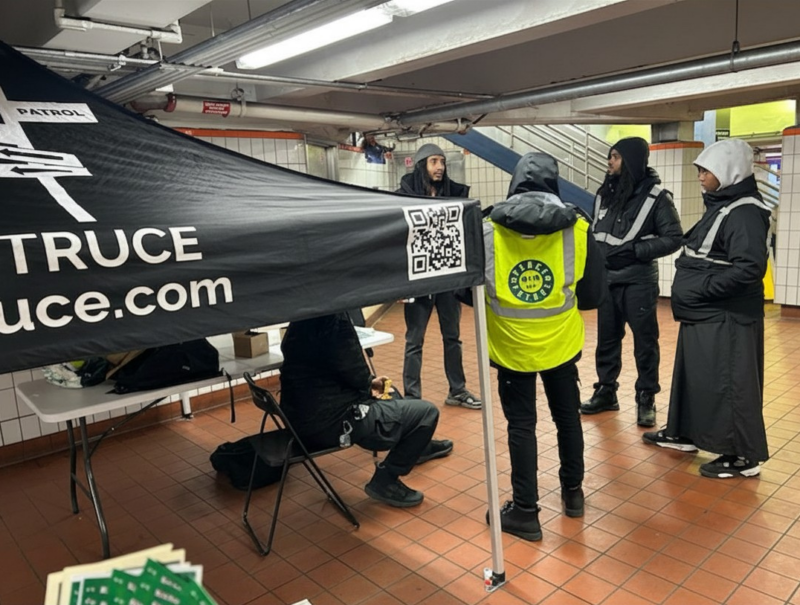
Image description: DATA CoLab West Philadelphia coordinator meets with peace patrollers inside a SEPTA station.
Although summary offenses are the lowest level of criminal offense in Pennsylvania, they still carry collateral consequences. Philly Truce was concerned that the increased enforcement would result in increased system involvement for Black and brown youth, unhoused folks, those who are financially vulnerable, and Philadelphians that have simply become accustomed to the underenforcement of fare evasion. After consultation with the West Philadelphia DATA CoLab coordinator and the District Attorney Office’s Racial Justice Task Force, Philly Truce identified a means to inform riders of the changing climate in enforcement, while advocating for and supporting decreased system involvement and promoting shared responsibility of core societal infrastructure.
Philly Truce produced a public service announcement flyer that reminded passengers of SEPTA rules for riders, fines, penalties for fare evasion, and information about resources for financially compromised riders. Philly Truce wanted to ensure that riders are aware of the consequences, including the consequences of a failure to appear for a summary notice hearing. Philly Truce trained SEPTA Peace Patrol participants to inform riders of the importance of appearing in court to address fare evasion citations and other public transportation related matters. A fare evasion citation can lead to $200-$500 in fees and, in extreme cases, 30-90 days of jail time if the accused ignores all court summons and fails to appear.
Philly Truce passionately believes in second chances and grace, so educating riders about the severe punishment that could arise from failing to appear in court was important to their patrol. The DATA CoLab also supported Philly Truce’s goal by sharing the fare evasion data with the DAO Racial Justice Task Force. This helped facilitate conversations regarding the remedies and opportunities for accountability that exist when sanctioned riders charged with fare evasion appear to their scheduled summary hearing. Philly Truce wanted to ensure people understood that failing to appear will greatly increase the likelihood of financial, socioeconomic, mental, and physical distress for the most vulnerable populations of Philadelphia. The disproportionate harm to vulnerable populations, specifically Black and brown riders, is an example how community-based organizations like Philly Truce provide opportunities for education and transparency to community members.
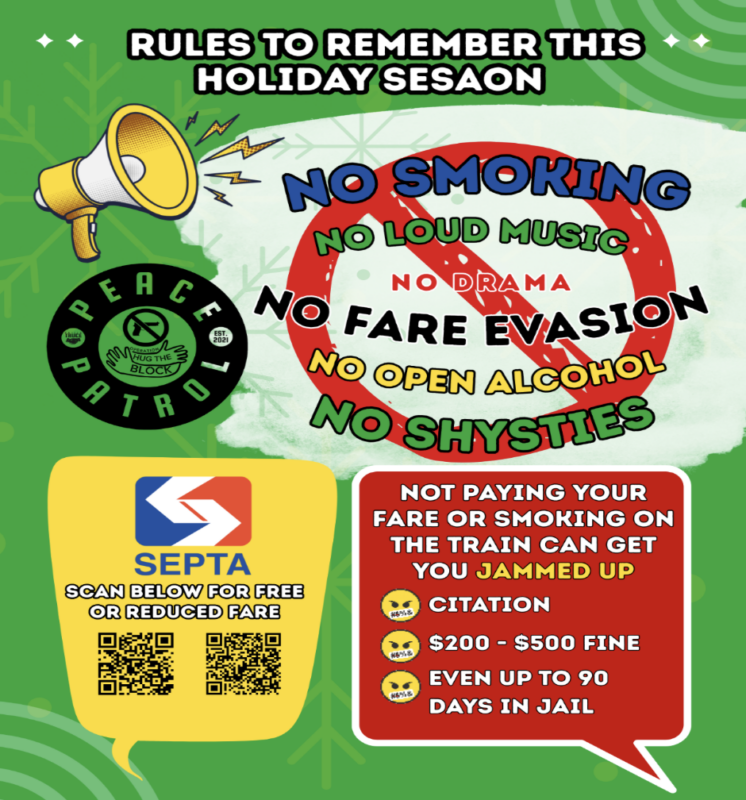
Image description: Peace patrol flyer in festive green and red colors stating “Rules to remember this holiday season: no smoking, no loud music, no drama, no fare evasion, no open alcohol, no shysties. Not paying for your fare or smoking on the train can get you jammed up (citation, $200-$500 fine, even up to 90 days in jail).” The poster also has QR codes for SEPTA free and reduced fare options.
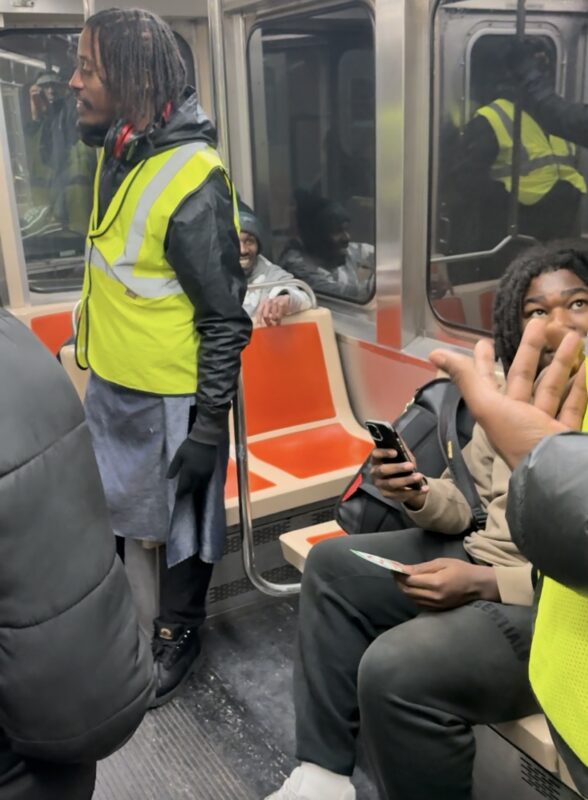
Image description: Peace patrollers talk with a passenger on the Broad Street Line.
SEPTA Peace Patrol Results
In the 21 days of Septa Peace Patrol that occurred in December of 2025, there were 39,201 total engagements. There were 12,245 engagements on the Market Frankford Line and 26,956 engagements on the Broad St Line. Additionally, 90% of travelers responded “YES,” to the question, “Do you want to see PEACE PATROL on SEPTA on a regular basis?” Outside of engagements and passenger reception, the remaining data collected on Septa Peace Patrol will require further analysis which will inform and lend to the growth of Septa Peace Patrol, as well as inform future community-based violence interventions and advocacy work.
Acknowledgements
The DATA CoLab is honored to work with organizations like Philly Truce
We welcome feedback, comments, and inquiries to collaborate with the CoLab or support for the associated community partners at [email protected].
The DATA CoLab is made possible through funding from the Pennsylvania Commission on Crime and Delinquency (PCCD).
- “Theft of services” includes fare evasion but also may include other similar offense types. All theft of services arrests/citations are available in the DAO Data Dashboard. Summary Arrests—PhilaDAO Data Dashboard. https://data.philadao.com/Summary_Arrest_Report.html