
District Attorney’s Transparency Analytics (DATA) Lab
The District Attorney’s Transparency Analytics (DATA) Lab constantly strives to iterate and improve our reporting on data about the criminal legal system in Philadelphia.
Key Takeaway: We have changed the time period for our Case Outcomes Sankey graphic from nine months to 24 months between arrest and case disposition to better account for Homicide: Shootings and Non-Fatal Shootings. The nine month time period will be retained for our Incident-Arrest-Charges Sankey.
Since November 2021, we have published monthly Incident-Arrest-Charges (IAC) “Data Snapshots” showing the relationship between incidents reported to police, arrests made by police, and cases charged by the Philadelphia District Attorney’s Office (DAO).

In November 2024, we reworked this graphic into a new version to better show the flow of incidents, arrests, and cases in the Philadelphia criminal-legal system. We also added a new felony-level case outcomes flow chart that improved on previous work and provided more data than previously possible for Homicides and Non-Fatal Shootings.
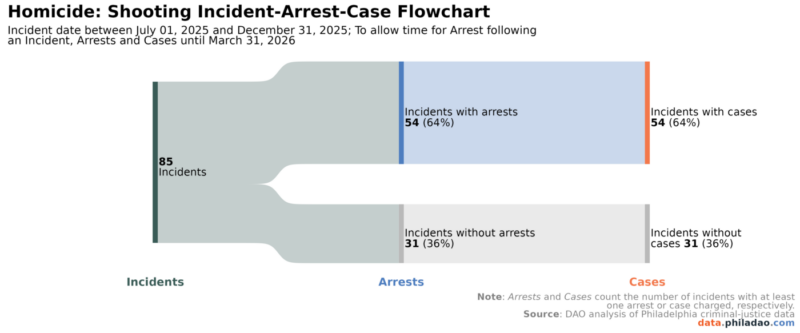
Incident-Arrest-Case (IAC) Sankey for Homicide: Shootings
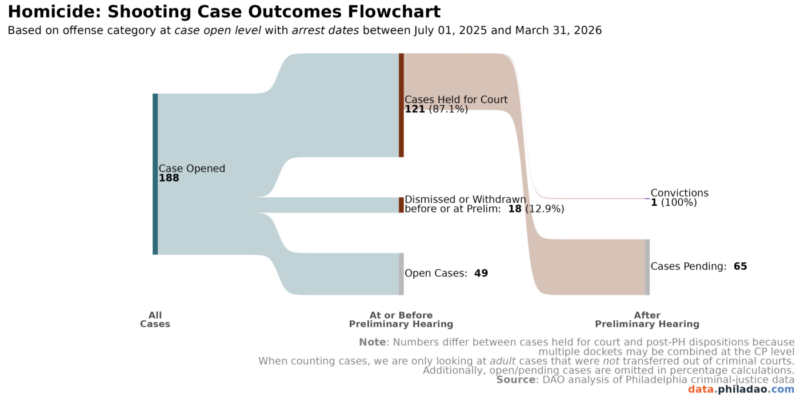
Case Outcomes Sankey for Homicide: Shootings
For the IAC graphics beginning in 2021, we used a six-month incident date window to count incidents. We then looked forward three months from this window, allowing up to nine months to pass from incident date to examine resulting arrests and cases charged. In creating the new IAC Sankey graphic in November 2024, we retained this methodology and will continue to use it going forward.
In November 2024, we also applied the same time period to the Case Outcomes Sankey graphics for Homicide: Shootings and Non-Fatal Shootings, using the arrest date as the beginning of the period and looking ahead nine months for disposition dates (i.e. the date on which a court case is resolved).
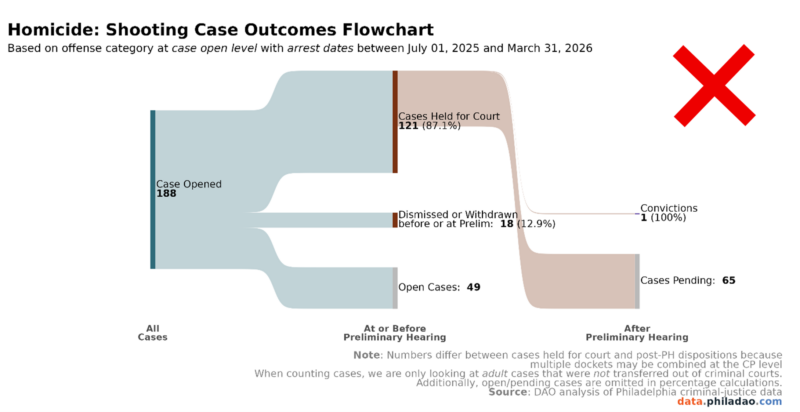
For the Case Outcomes Sankey, we realized the nine-month period is not long enough for these types of cases to actually resolve, which is reflected in our recent snapshots. For example, our March 2026 Data Snapshot shows 1 Homicide conviction with 65 Homicide cases pending and 11 Non-Fatal Shooting convictions with 110 cases pending. We used our Public Data Dashboard Case Length Year End Report to determine a more appropriate time period, and found that for shooting-related Homicides, the median time from arrest to disposition ranges from ~700-800 days. For Non-Fatal Shootings, median days to disposition ranges from ~400-500 days. These ranges far exceed the nine-month (~270 days) period we were previously utilizing for this analysis.
We have changed the time period to be a total of 24 months between arrest date and disposition date. By making this data-informed change, our reporting now better aligns with and brings additional visibility into the actual day-to-day operations of the Philadelphia criminal legal system.
A comparison of old versus new is below:
Old: The previous nine-month period between arrest and case resolution was not long enough for cases to resolve; most cases shown are still pending.
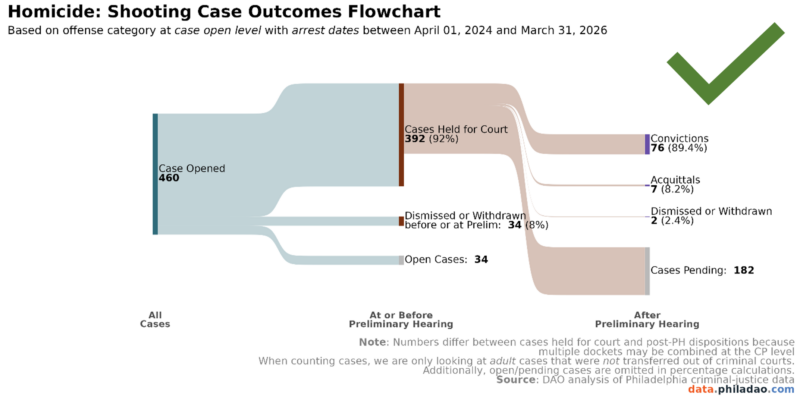
New: Even though increasing the time period captures more cases, utilizing a longer 24-month period gives a more holistic view of how these cases progress to resolution. The cases that are still pending are likely more recent cases within the period.
We are eager to hear what you think about these visuals and if they are helpful in understanding a complex system. Please submit feedback, questions, and comments to [email protected]. We also encourage you to explore the rest of the Public Data Dashboard for reports showing the latest stats and research on Philadelphia’s criminal legal system.