PHILADELPHIA (October 16, 2026) — District Attorney Larry Krasner, elected officials and justice partners today jointly released a report analyzing the negative impacts of the Thurmond Amendment of the Fair Housing Act on individuals and communities across Pennsylvania.
The report titled Housing Denied: Quantifying the Impacts of the Thurmond Amendment in Pennsylvania examines the 1988 amendment to the Fair Housing Act which enables landlords to deny housing to individuals convicted of selling and manufacturing drugs. Under the law, landlords can deny housing to anyone with a past drug crime conviction, no matter the type or quantity of drugs involved or how old the conviction. The report estimates that 91,644 people were convicted of drug selling and manufacturing charges between 2007 and 2025 in Pennsylvania, and could have potentially been denied housing under the Thurmond Amendment.
“Stable housing is one of the strongest predictors of successful reentry and reduced recidivism,” said District Attorney Larry Krasner. “The Thurmond Amendment — authored and championed by staunch segregationist U.S. Senator Strom Thurmond — permanently disqualifies people from housing protections based on certain drug convictions, regardless of the severity of the offense or the person’s rehabilitation since. Rather than contribute positively to healthy communities, this law works directly against the goals of public safety that our office is charged with prioritizing.”
Key takeaways from the report include:
- An estimated 91,644 people were convicted of drug selling and manufacturing charges between 2007 and 2025 in Pennsylvania, and could have potentially been denied housing under the Thurmond Amendment. Given the time period constraints and limitations of criminal-legal databases, this is a significant undercounting.
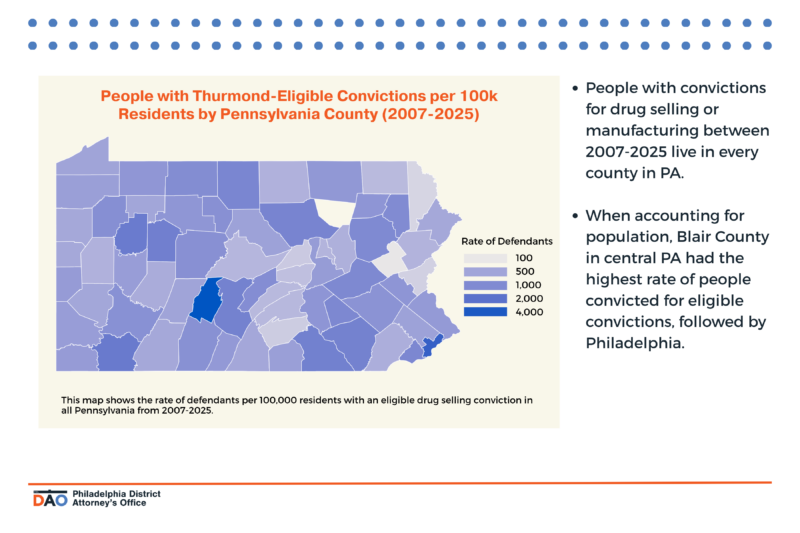
- Thurmond-eligible convictions occur throughout Pennsylvania, and tend to concentrate in the more populated corners of Philadelphia, Pittsburgh, Erie, and Scranton. Convictions in Philadelphia courts accounted for 34% of statewide totals.
- Due to a variety of factors, including shifting legal and cultural landscapes around illegal drugs, Thurmond-eligible convictions have decreased statewide since 2007, with some year-to-year fluctuation. From 2007-2025, an average of 4,824 people have been convicted each year, though the statewide totals have been well below that since 2019.
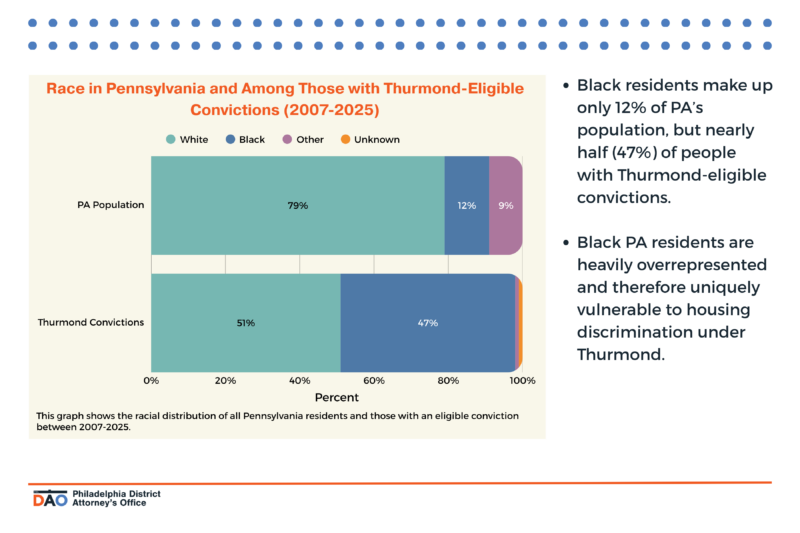
- While Black people make up only 10-12% of Pennsylvania’s population, Black defendants represented more than 46% of Thurmond-eligible charges during the study’s time period.
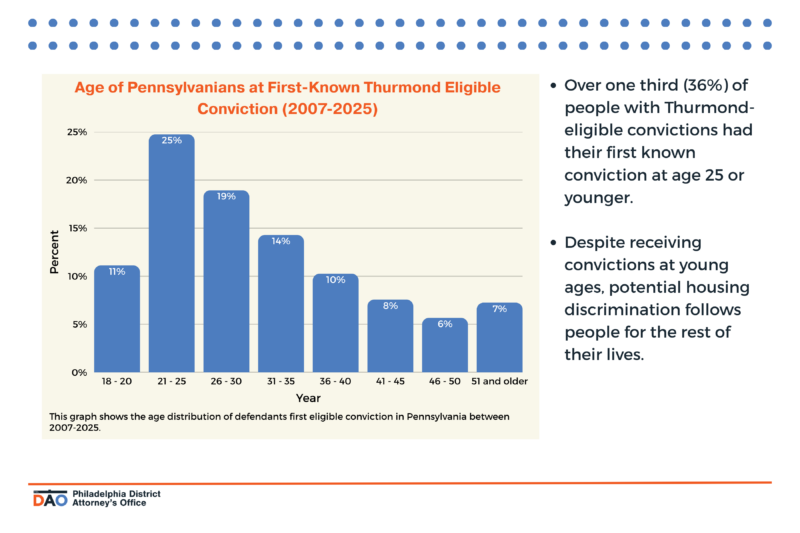
“I was 18 years old when I received the conviction that would follow me into the housing market decades later,” said Yusuf Dahl, CEO of The Century Promise and a leading advocate to repeal the Thurmond Amendment. “I rebuilt my life, built a career and a family, and still discovered that a mistake I made as a teenager determined where I was allowed to live. More than 91,000 Pennsylvanians face this same lifetime barrier, many for mistakes made when they were young. We now know the scale of the harm in Pennsylvania. It’s time to repeal this nearly 40-year-old relic of the ‘War on Drugs’ that continues to punish people by restricting where they can live long after they have served their time.”
“Philadelphia and many large cities are facing an affordability crisis, especially when it comes to housing, and for a subset of the population who have a drug conviction, their options are even slimmer,” said City Councilmember Curtis Jones, who represents the 4th Council District and is a member of Council’s Committee on Housing, Neighborhood Development and the Homeless. “When you know better, you do better, and we can do better by simply repealing a policy that is rooted in racism.”
State Rep. Morgan Cephas, who represents the 192nd Legislative District and is co-sponsor of House Bill 1492, known as the PA Fair Future Act, added: “We are a nation of second chances, but when we talk about second chances we cannot ignore a population that is clearly discriminated against. We know that housing is a critical foundation in someone’s ability to move along the economic spectrum. This amendment clearly stands in the way of that. I thank the DATA Lab for bringing greater visibility to this issue and helping us quantify the scope of the problem. I encourage my colleagues in the Pennsylvania Legislature to be part of the solution by passing the PA Fair Future Act.”
The report examines arrest and court data on adults charged with violations of state drug crime statutes between 2007 and 2025. Cases are measured by first-known, Thurmond-eligible drug crime convictions in Pennsylvania and are summarized by county and defendant characteristics (age, race, etc.). While it is unknown whether all of the individual defendants identified in this conservative estimate personally experienced discrimination in seeking housing, it can be reasonably concluded that this law has impacted thousands of Pennsylvanians in the nearly 40 years since the amendment’s passing.
“I know first-hand what it is like to face the stigma of being formerly incarcerated while trying to rebuild your life,” said Tonie Willis, founder and executive director of Ardella’s House. “Our society claims to offer ‘second chances,’ but often makes it harder for individuals with a record to successfully reintegrate with laws like the Thurmond Amendment. This issue affects not only individuals with a drug conviction, but it affects their families and our communities.”
“My conviction was almost 10 years ago, and even after serving my time, I continue to carry a permanent felony record—a continuous, compounding barrier to rebuilding my life and fully contributing to my community,” said Tara Bruno, a formerly incarcerated individual. “I went to college, I earned a master’s degree yet, day after day, this record creates immediate obstacles, particularly in obtaining equitable housing and meaningful employment. Decades-old policies, like the Thurmond Amendment and rigid screening laws, allow housing providers and employers to shut the door on individuals without considering the facts of a case, time passed, or actual innocence.”
“Thurmond-eligible convictions have impacted communities throughout Pennsylvania, but the burden has not been equally distributed. Black Pennsylvanians make up only about 10 to 12 percent of the state’s population, yet they account for more than 46 percent of these charges, despite the fact that people of all races use drugs at similar rates,” said Oren Gur, Director of the DATA Lab. “At the DATA Lab, our mission is to provide data that does more than describe these harms; it should drive accountability and reform. By making this information accessible, we hope to help policymakers and communities in Philadelphia and beyond build a fairer, more transparent system.”

###
CONTACT:
Solomon D. Leach, [email protected]